Protecting yourself as a non-school alternative provision
The rules are tightening. In the light of the new Schools and Wellbeing Bill and incoming DfE Non-School AP standards more questions are being asked of NSAP’s. In some areas blanket warning letters are going out from LA’s as they work to show they are protecting themselves in terms of placing students in ‘unregistered schools’.
As NSAP leaders you want to reduce your risk as much as possible, of either being the subject to one of Ofsted’s unregistered school investigations or visits or, in a worse case scenario, being prosecuted for running an unregistered school. As a reminder to calm your feelings of panic, unannounced Ofsted visits with cautions and body camera do feel intimidating but very few people are actually prosecuted and you are given chance to change your practice if it isn’t right.
It’s getting more relevant
This is more important than it was, Ofsted opened 260 investigations into unregistered schools last year with a sharp rise in referrals. Their practice of visiting more NSAP’s during school inspections gives more chance for them to discover concerns.
The law is also changing, the ‘full-time’ descriptor in DfE guidance has always been vague and is being replaced with a more specific one “whether a child could reasonably be expected to receive all or the majority of their education at the setting”. There will be more guidance and regulation around this following in 2027 but it is good to plan to work around that new definition to future-proof your setting. The new DfE standards for NSAP which the DfE have said will become mandatory propose a limit of either 12 week full-time placements or no more than 2 days (or four sessions) a week for each child.
DfE guidance to schools and LAs around using AP now tells them to check the status of a provider. In the past commissioners would happily ask settings to take young people and not really worry about the consequences. They are more likely to ask a provider to demonstrate their status now.
So what are the rules?
Section 463 of the Education Act 1996 defines an independent school as any school at which full-time education is provided for five or more pupils of compulsory school age, or for at least one pupil of compulsory school age who has an education, health and care (EHC) plan or is looked after by a local authority, and which is not a maintained school or a non-maintained special school.
Under Part 4 of the Education and Skills Act 2008 an independent school must be registered with the Secretary of State before it operates. Conducting an unregistered independent school is a criminal offence under section 96 of that Act. On conviction the person responsible is liable to an unlimited fine, imprisonment for up to six months, or both. Ofsted, as the Chief Inspector, has the power under section 97 to enter and inspect premises where it has reasonable cause to believe the offence is being committed, and intentionally obstructing an inspector is itself an offence.
The DfE's guidance for local authorities, updated in September 2026, is explicit that a setting is operating illegally if it operates full-time and provides education to any of the groups above, “whether this was intended or not”, and that settings providing alternative provision to schools and local authorities are not exempt.
What counts as hours?
The whole ‘envelope’ of the young person’s day counts as their hours. That means that lunch, breaks, arrival, tutor time etc count as well as any formal taught time. It is also important that time with you doesn’t block out another potential education time. If you only have learners for 10 hours but it’s 11-1 every day then it may stop them getting to anywhere else to learn all week.
What principles can make you feel more confident?
· Act whenever a learner you educate has no other setting to attend – if you’re the sole educator of a young person it increases your risk.
· Check your status regularly and record your checks
In the same way you may build in regular checks of your fire safety or SCR build in reviews of pupils hours and registration status and record them.
· Cap the hours of your offer and formalise this in a policy
Make sure commissioners and staff are clear of the limits of your offer.
· Keep records of the wider offer for every learner, not just your input
How can you be sure you’re not the main educator of a learner without fully understanding their full offer? This changes too so make sure it is a conversation at review points as well as information gained at referral
· Have a written agreement with commissioners that they remain responsible for the learners full-time education, safeguarding and attendance
· Evidence your quality against the DfE national standards
If Ofsted do visit then they will check things like your safeguarding, health and safety and your SCR. Self-evaluating against the DfE’s standards helps you check anything they might scrutinise. We’ve plenty of resources around this on our website
· Keep all your paperwork to hand in case of a no notice inspection
The worst thing is Ofsted turning up and you have to scrabble around for evidence. Just keep a file to hand with the information above, keep it up-to-date and then, if someone turns up, no problem.
Reducing risk
In reality, with grey areas around hours and definitions of full-time there isn’t always a clear answer about whether to do something or not. The key is to reduce your risk of running an unregistered school as much as possible whilst still being able to support the young people that you do, as well as you do.
It’s not just the learners
As well as the hours of learners Ofsted are also looking for other pointers that you could be trying to run a school. Think through the following:
· Make sure your policies are geared to a non-school provision. Some settings use policies they’ve grabbed from schools and wording reflects schools structures, guidance and rules. Include clear definitions of your status across your policies and paperwork
· Avoid the language of school. Take a look at your website and social media posts. If they talk about you as a school or use school language, words like headteacher or pupil or full-time then they may support the theory that you are trying to work as an unregistered school
· Make it clear how you specialise. You’re unlikely to be trying to run a school with a very specialised approach and restricted curriculum. Specialisation is one of the great plus points of being a NSAP. Trying to replicate a school offer will increase your risk. Specialising around a very select approach you know works for young people will help reduce it.
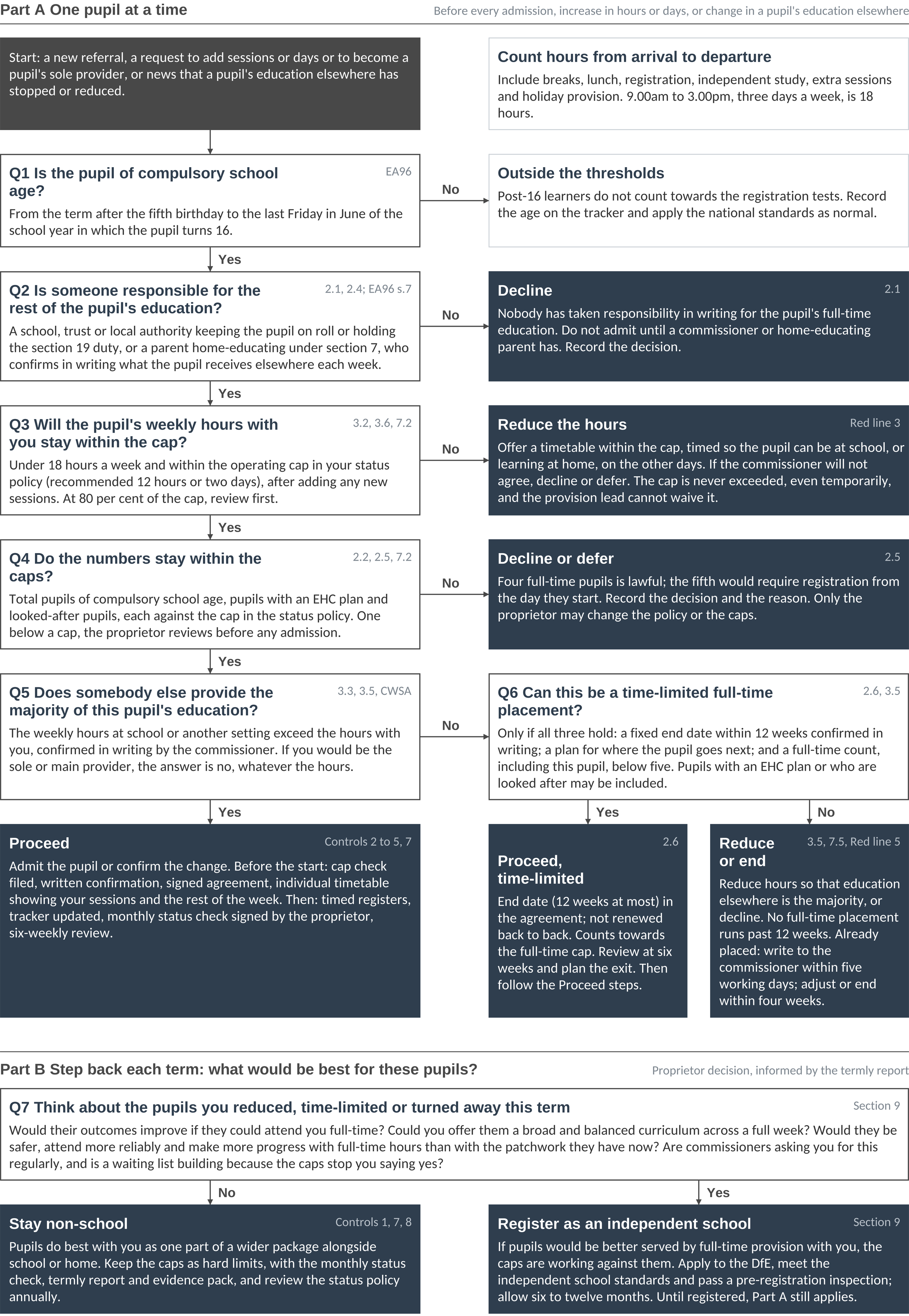
The difficult scenarios
That all looks fairly straightforward but we know life isn’t like that! Here’s some specific questions that we often see in our conversations with NSAP leaders.
1 You work with a learner for very few hours, definitely not full-time but the learner doesn’t do anything else.
Under the current law the provider would be on pretty firm ground. It is hard to describe a few hours as “full-time education”, it does not stop the pupil being educated elsewhere, and Ofsted’s published investigations are overwhelmingly of settings that run something resembling a school day. There is still a risk as the DfE’s caveat is that fewer than 18 hours does not automatically mean the education is not full-time, and the fact that the pupil receives nothing else is exactly the circumstance in which Ofsted will look harder. But a provider offering low hours like two hours a day is unlikely to have problems at the moment.
The position does change when the Children’s Wellbeing and Schools Act test comes into force. The question then is whether the child receives all or the majority of their education at the setting. The important point for the provider is that reducing hours does not help here. Cutting from ten hours to six still leaves the setting providing 100 per cent of the pupil’s education. If your learners don’t have an EHCP aren’t LAC and you only have up to 4 learners in this position no problem. Otherwise your best way forward is probably to go back to commissioners and to try to work with them to provide additional education options for the young person. A local authority and school should be providing a full-time education for learners unless there are issues with their physical or mental health.
2 You work with EOTAS pupils
EOTAS is the highest-risk category of for a non-school provider. They are EHC plan pupils and there is no school in the background to supply the majority of their education.
The questions are therefore the same as for any other pupils, does this setting provide all or the majority of this child’s education? Where the local authority has commissioned a package across several providers, with tutoring, therapy, online learning and the setting each taking a part, and the setting’s hours are a minority of the total, the provider is in the same position as any part-time AP. It needs the local authority’s written confirmation of the whole package, with the hours of each strand and it needs to review that at least every six weeks.
Where the setting is the main or sole EOTAS provider for a child for more than a short transitional period, the proper approach is to register, or to decline the placement.
3. Pupils offered time in school or other AP but is not attending
Under the current rules a provider offering twelve hours has a good argument: the hours are below the indicator, a school place is available and attendance is the school’s responsibility, so the provision does not preclude full-time education elsewhere.
A good response though is to set a regular reviews of the offer given to your learners and then act where this wider offer is failing. Ask the school for the pupil’s attendance at each review point. It is in your interest as a provider to support the learners attendance elsewhere if possible and strong partnerships across APs or between home schools and APs can only be positive for the young person, the reputation of your AP and future referrals.
Help is available
We have put together a framework to support settings to reduce their risk of running an unregistered school to as low a level as possible. It contains a framework to help explain how to work and then templates for the policies, agreements and tracking you need to keep a strong evidence base in case of inspection. It also includes a consultation meeting with us so you can talk through the specific examples you have in your setting.
We’ve also written a lot of support for NSAP you can get access to on the website:
Should we register our AP?
https://www.closethegaps.co.uk/registering-an-alternative-provision
https://www.closethegaps.co.uk/updates/should-we-register-our-non-school-ap-with-ofsted
https://www.closethegaps.co.uk/updates/becoming-a-registered-school
DfE Non-Standards support
https://www.closethegaps.co.uk/non-school-ap-standards
Unregistered school inspections
https://www.closethegaps.co.uk/updates/unregistered-schools
DfE guidance
https://www.closethegaps.co.uk/ap-guidance
https://www.closethegaps.co.uk/updates/dfe-guidance-for-non-school-alternative-provisions