Should we register our Non-School AP with Ofsted?
Should a Non-School AP (NSAP) register with Ofsted?
If you’re a Non-School Alternative Provision (previously known as ‘unregistered’) leader then I’m certain you’ve found yourself thinking through this question. I regularly hear that local authorities are pushing NSAP’s to register and some local authorities and academy trusts will only work with registered providers. I also meet NSAP leaders who would love to be able to offer more hours to their young people but are restricted by the rules around a ‘part-time’ offer.
At the same time there is a reluctance from APs to move from what are often very specialised offerings to the more ‘broad and balanced’ curriculum needed for registration and to add Ofsted inspections to their list of experiences. Registering isn’t an easy process and takes good attention to detail and increased resources. So, how can you decide what is right for your provision? Well, the fact is, the right answer depends very much on your context and it takes thinking about. When we work with APs to advise around this sometimes it seems right to register and sometimes not. Here’s some thinking points to help you make the decision.
1) Know the rules
If you register with the DfE as a NSAP you have to do so as an independent school. ‘Independent schools’ take many forms from small specialist SEND settings through to large private schools like Eton. If you register you’ll become an independent school – whether or not you are classed as an ‘alternative provision’ still is purely down to what you decide the ethos of your school is and what you decide to call yourself. Some independent school take only pupils on their own roll, some take only dual registered pupils, some work on a temporary placement model, some full-time and permanent. All have to meet the Independent School Standards. These aren’t a developmental framework – to be registered, Ofsted have to have checked and passed you against all the standards – you can’t fail any in a pre-registration inspection.
It’s important to know what you can and can’t do as a NSAP. There is a presumption that NSAPs can just move smoothly through to registration but not all model of AP fits the standards.
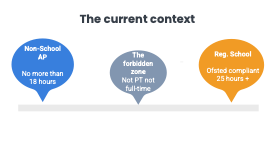
If you’re a non-school AP you can’t do more than 18 hours at most with your young people but also, you can’t register as a school unless you offer your young people a full-time timetable. There is a gap between these – if your young people aren’t ready for a full-time timetable then it isn’t appropriate to register.
The DfE say: “An independent school is defined as any school at which full-time education is provided for five or more pupils of compulsory school age, or for one or more such pupils with an EHC plan or a statement of special educational needs or who is “looked after” by a local authority”
If you want to be able to deliver a full-time education to 5 or more pupils or one or more LAC or EHCP young people then you’ll have to register.
If you’re choosing not to register then you will have to make sure you follow the rules around part-time and protect yourself in terms of risk around running an unregistered school. We cover this in more detail on a couple of our updates pages.
What’s your ethos?
We have talked lots of times before about the importance of knowing your mission as an AP, of being really clear about the young people you are set up to help and how you do this. If you’re clear about this then it helps the decision making. If you are set up to work with young people struggling to access mainstream school - through anxiety for example - those who can only access a couple of hours learning a day, then why register? If you have your success through a really specialised vocational approach, maybe animal care or construction and that is your USP then registration will change your whole approach. Would registration result in mission drift? Would it change what you’re good at and who you are trying to help?
What is your local context?
There is a hugely variable approach to NSAP across both local authorities and academy trusts. Some local authorities say they won’t commission any places with NSAPs, some academy trusts are the same. Some LA’s are brilliant and have an AP strategy that makes use of all their good providers. For your commissioners how important is it that you are registered? Will it make a big difference to the demand for your places? As well as thinking about your immediate situation it is also good to look at long-term strategy in the LA and how they plan to use AP and independent provision in the future. Nearly all LAs have long-term goals to use less provision but this has to be balanced with a lack of capacity in the system and increasing numbers of exclusions, suspensions and pupils struggling in mainstream.
It’s important to have an understanding of the national context here too. There has been a welcome move to support NSAPs through the DfE’s Non-School AP standards but there is also probably incoming legislation clarifying the amount of time you can take young people and that you can only take them when they’re also on roll at a registered school. As LA’s are unlikely to be able to place into NSAPs when pupils aren’t on roll with a school it will probably make registered settings more popular, at least in the short-term. Again, we cover this in more detail in other blog posts.
What do your young people need?
Putting the needs of your young people in the centre of your decision making can never be a bad thing. Some settings have a natural progression to registration. Their young people are thriving, they are ready for a full-time offer and there aren’t other options for them. The decision becomes a clear way to meet needs that no one else locally can. For other settings their young people just aren’t at that stage, when they do progress they are able to move to good inclusive full-time provision locally. Do you need to register in order to be able to meet need?
Could you meet the standards?
As has been already mentioned you have to meet all the independent school standards to be able to register. These include common things you’ll already have in place like staff checks and risk assessments. The big areas of difference from a NSAP are normally, curriculum and planning, premises and leadership structures. You’ll need a fully planned ‘broad and balanced’ curriculum that includes maths, english, science, humanities, arts, PE, PSHE and technology. Your premises will have to meet school standards with things like a medical room and warm tap water at less than 44 degrees Celsius. Your leadership will have to reassure Ofsted that the standards can be met consistently over time. There are over a hundred different standards and they take a good level of attention to detail to be able to meet. Only around 50% of settings pass first time and given the investment needed to register as a school it is important to be as successful as possible in building your evidence for these.
Do you have the resource?
Meeting registration standards costs both in time and financial resources. A pre-registration inspection costs £2500 currently but is likely to rise to at least £4000 sometime in 2026. That is without investment that you may have to make in staff, premises and systems in order to meet the standards.
Are you thinking long-term?
Passing the pre-reg inspection is just step one. You need to be able to do this but then to successfully work to Ofsted frameworks for the continued time you’re working as a school. That means understanding the framework and being able to evidence the way you meet it. It means staff undergoing the stress of an Ofsted inspection every couple of years and the focus this places on developing practice and tracking impact.
Next steps
We regularly work with organisations to do two things. We do options appraisals for organisations thinking about registering. We look at their organisation, its ethos and resource and the local context and help support leaders, trustees or board members to make an informed decision. We also help settings to get registered and build their evidence base so they can pass the inspections and are set up for long-term success. If you’re interested in either of these approaches then do get in touch. You can find out more about our options appraisals here.